
.svg)
.svg)
.svg)
.svg)
.svg)
 русский
 فارسی
فارسی العربية
 English
 Dairy Powder
  Creamer
  Butter
  Cream
Cream  Milk
Milk  Cheese
 A Complete Guide to the Amount of Protein and Dry Matter in Milk Powder
This blog provides a detailed overview of protein and dry matter in milk powder, explaining how these values are measured, their typical ranges, and why they are important for nutritional, functional, and economic value.
Milk powder (also called dried milk) is a widely used dairy product, prized for its shelf stability, ease of transport, and convenience in food formulations. To evaluate its value — nutritionally, functionally, and commercially — two key metrics are commonly considered: protein content and dry matter (total solids). In this article, we’ll explore what these quantities mean, how they are measured, typical ranges, and why they are important in practice.
What Is “Dry Matter” (or Total Solids) in Milk Powder?
Definition and Importance
Dry matter (DM), or total solids, refers to everything in milk powder except water. When all water is removed (e.g., by evaporation), the remaining components — proteins, fats, lactose, minerals, and other non-volatile compounds — make up the dry matter.
Understanding dry matter is crucial because it:
-
Indicates the amount of “actual nutritive and functional material” per unit weight.
-
Allows comparison between powders with different moisture levels.
-
Influences shelf stability, microbial safety, and overall quality (since moisture often drives spoilage and caking).
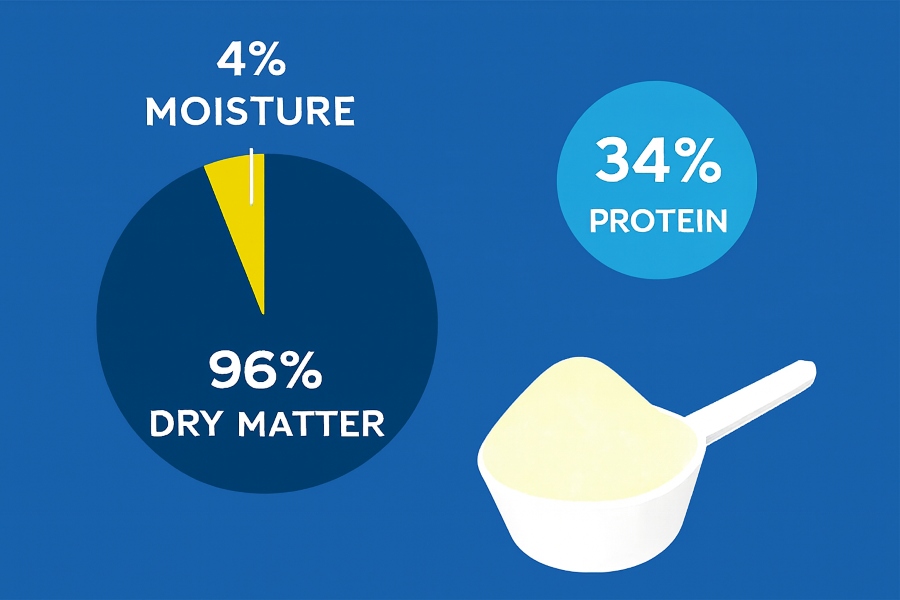
High-quality milk powders typically have low moisture content, resulting in dry matter above 94%, depending on storage and processing conditions. Scientific studies on milk protein concentrates show DM values ranging from 94.03 g/100 g to 96.09 g/100 g, demonstrating excellent stability.
Components of Dry Matter
Dry matter can be subdivided into:
-
Protein (casein + whey proteins)
-
Fat (in whole milk powders)
-
Lactose and other sugars
-
Minerals / ash
-
Minor components (vitamins, bioactive peptides, trace compounds)
When someone says a powder has “X% protein,” they usually refer to the percentage of protein in the dry matter, not including moisture. This distinction is essential because moisture differences can change the apparent protein content.
Protein Content in Milk Powder: What to Expect
Typical Ranges
Protein content varies depending on the type of powder:
-
Whole Milk Powder (WMP): Contains fat, so protein is relatively lower (~25–27% by weight).
-
Skim / Nonfat Milk Powder (SMP / NFDM): Fat is removed, so protein proportion is higher (~36% on a dry basis).
-
Milk Protein Concentrates / Isolates (MPC / MPI): Protein is concentrated, reaching up to 90% on a dry matter basis.
Protein on Dry vs. Wet Basis
It’s important to distinguish between “as-is” (wet) and “dry” basis protein percentages. For example, if a powder has 94% dry matter and 25% protein on a dry basis:
0.94 × 0.25 = 23.5% protein on a wet basis.
Many scientific publications report protein on a dry basis to standardize comparisons.
Amino Acid Profile and Quality
Beyond quantity, protein quality matters: amino acid composition affects nutritional value, digestibility, and functional properties (solubility, foaming, gelling).
Milk proteins are mainly casein (~80%) and whey (~20%). Casein supports slow digestion and structural stability, while whey is more soluble and rapidly digested. MPCs often control the casein-to-whey ratio, affecting flowability, solubility, and gelling.
How Protein and Dry Matter Are Measured
Moisture / Dry Matter Determination
Standard methods include:
-
Oven drying (gravimetric): Sample dried until constant weight.
-
Karl Fischer titration: Chemical method suitable for low moisture.
-
Infrared moisture analyzers: Fast estimation via IR absorption.
Careful sampling is critical to avoid moisture uptake that could distort results.
Protein Determination
Common methods:
-
Kjeldahl nitrogen analysis: Organic nitrogen converted to ammonium, distilled, titrated, multiplied by 6.38 for milk proteins.
-
Dumas combustion: Sample burned, nitrogen measured; faster and automated.
Protein can then be expressed relative to dry matter if desired.
Why These Values Matter
Nutritional Labeling and Consumer Value
Consumers should know if protein values are reported on a dry or wet basis. Higher protein increases value for:
-
Dairy drinks, protein shakes, powders
-
Baked goods, sports nutrition, specialized nutrition
-
Infant formula and medical nutrition
Functional Performance in Food Systems
Protein proportion affects:
-
Solubility and reconstitution
-
Flowability and caking
-
Gelling, foaming, emulsification
Processing variables such as heat treatment, standardization, and casein-to-whey ratio influence powder properties like density, particle size, and stability.
Stability, Shelf Life, and Quality Control
Moisture impacts:
-
Microbial growth
-
Caking/clumping
-
Chemical reactions (Maillard browning)
-
Loss of functional properties
Manufacturers aim for stable, low moisture, with regular quality control checks on protein and moisture.
Cost & Economic Value
Higher protein-to-dry matter powders command premium prices in sports nutrition, infant formula, or functional dairy ingredients. Advanced processes like ultrafiltration concentrate protein while reducing lactose and minerals.
Challenges and Innovations
Hygroscopicity & Moisture Uptake
Powders absorb moisture from the environment. High whey content increases hygroscopicity. Packaging, storage, and desiccants are critical.
Heat Treatment and Denaturation
Heat can denature proteins, altering solubility and functional properties.
Balancing Casein and Whey Ratios
Specialized powders require precise casein-to-whey ratios to achieve desired solubility, gelling, and texture.
Innovations in Concentration Technologies
Membrane separation (ultrafiltration, diafiltration) enriches protein while preserving native structures, producing MPCs with high protein content and functionality.
ChaltaFarm Milk Powders — High Protein, Reliable Quality
ChaltaFarm’s SMP and WMP are produced with controlled composition to ensure consistent protein quality and functionality:
-
SMP: 34–36% protein (fat-free dry matter), ideal for high-protein formulations.
-
WMP: Minimum 34% protein (fat-free dry matter), balanced nutritional profile with natural milk fat.
Both powders provide excellent solubility, stability, and nutritional performance for a wide range of dairy and food applications.
Protein Content in the Dry Matter of Milk Powder
If the protein and fat-free dry matter content of milk is above standard—for example, if the fat-free dry matter of milk is 7.8% and its protein is 3.2%, and the fat-free dry matter in the cream is 3–5%—then the protein content in the fat-free dry matter of milk powder with 3–5% moisture will be at least 35%.
If lower-quality milk is considered, with protein and fat-free dry matter of 2.8% and 8.2% respectively, and 3–5% fat-free dry matter in the cream and 3–5% moisture in the milk powder, the protein content in the fat-free dry matter will be at least 33%. In all cases, with moisture between 3–5%, the protein in the fat-free dry matter of milk powder ranges from 33% to 36%.
Summary
Dry matter is the fraction excluding water; high-quality powders target >94% DM.
Protein content varies:
-
Whole milk powders: ~25–27%
-
Skim milk powder: ~36%
-
Protein concentrates/isolates: up to 90%
Protein values on a dry basis avoid distortion from moisture differences.
Protein quality (amino acid profile, casein vs whey) affects functionality.
Accurate moisture and protein measurement is essential for quality control.
Powder behavior (solubility, flow, shelf stability) depends on composition, processing, and storage.
Membrane separation technologies enable high-protein powders while maintaining functional properties.
Related Blogs

.webp)
.jpg)