

 русский
 فارسی
 العربية
 English
 Dairy Powder
 Creamer
 Butter
 Cream
 Milk
 Cheese
Strategies to Reduce Methane Emissions in Dairy Farming
Discover practical and science-based strategies to reduce methane emissions in dairy farming. Learn how feed management, animal health, feed additives, and manure treatment contribute to more sustainable dairy production.
Methane emissions are one of the major environmental challenges associated with dairy farming. Although methane is naturally produced during the digestive process of ruminant animals, its release into the atmosphere contributes significantly to global warming. As a result, reducing methane emissions has become an important focus of research in sustainable livestock production.
In dairy farming, methane is primarily generated through two processes: enteric fermentation in the rumen and the anaerobic decomposition of manure during storage and handling. Addressing these sources requires a combination of improved feeding practices, animal health management, breeding strategies, and more efficient manure treatment systems.
According to the Food and Agriculture Organization of the United Nations (FAO), several approaches can help reduce livestock methane emissions while improving production efficiency. However, their effectiveness depends on factors such as animal genetics, feeding systems, farm management practices, and regional conditions.
This article examines the main strategies used to reduce methane emissions in dairy farming, highlighting established practices, emerging technologies, and their potential role in more sustainable milk production.
1. Understanding the Main Sources of Methane in Dairy Farming
Before examining mitigation strategies, it is important to understand where methane emissions originate within dairy production systems.
1.1. Enteric Fermentation
Enteric fermentation is the natural digestive process through which microorganisms break down feed materials in the rumen, the largest compartment of a cow's stomach. During this process, methanogenic microorganisms produce methane as a byproduct of fermentation.
Most of this methane is released through belching, making enteric fermentation the primary source of methane emissions from ruminant livestock.
The amount of methane produced depends on several factors, including feed composition, forage digestibility, feed intake, and rumen microbial activity. Consequently, nutritional management is one of the main areas targeted by methane reduction strategies.
1.2. Methane Emissions from Manure Management
Manure is another important source of methane emissions in dairy farming. When manure is stored under anaerobic conditions, microorganisms decompose its organic matter and generate methane.
The amount of methane released depends on several factors, including manure composition, storage temperature, storage duration, and the type of manure management system.
Liquid manure storage systems can provide conditions that support methane production, particularly when manure remains in storage for extended periods.
Improving manure collection, storage, and treatment practices can therefore contribute to reducing emissions from dairy farms.
2. Improving Feed Quality and Nutritional Management
Feed management is one of the most practical approaches to reducing enteric methane emissions. The composition, digestibility, and nutritional balance of a cow's diet directly influence rumen fermentation and methane production.
2.1. Improving Forage Digestibility
The quality of forage plays an important role in dairy cow nutrition and methane production. Poor-quality forage with lower digestibility can reduce feed utilization efficiency and influence rumen fermentation.
Providing high-quality forage and improving forage digestibility can support better nutrient utilization and animal productivity.
According to FAO, improving pasture management, using suitable forage varieties, and adopting appropriate forage harvesting and preservation practices can contribute to more efficient livestock production and lower methane emission intensity.
Practical approaches include:
-
Selecting forage varieties adapted to local climatic and agricultural conditions.
-
Improving harvesting and storage practices to preserve nutritional quality.
-
Managing pasture growth and grazing intensity.
-
Combining high-quality forage with nutritionally balanced supplementary feeds.
The objective is to improve the amount of useful nutrients obtained from feed while maintaining appropriate rumen function.
2.2. Balancing Diet Composition
Diet formulation is another important factor in methane mitigation. The proportions of forage, concentrates, starch, fiber, and fats influence rumen fermentation pathways and the production of methane.
Research indicates that modifying the forage-to-concentrate ratio and adjusting dietary starch and lipid levels can influence enteric methane production.
For example, increasing dietary starch under appropriate conditions can shift rumen fermentation toward propionate production, reducing the availability of hydrogen for methane formation.
However, dietary changes must be carefully managed. Excessive starch or fat supplementation may negatively affect rumen function, milk fat production, or animal health.
Therefore, ration formulation should consider the nutritional requirements of dairy cows, their production stage, and the overall balance of the diet rather than focusing exclusively on methane reduction.
2.3. Using Precision Feeding Techniques
Precision feeding involves adjusting feed composition and nutrient supply according to the specific requirements of individual animals or groups.
By matching nutrient intake more closely to production requirements, dairy farms can improve feed utilization and avoid unnecessary nutrient supply.
This approach can contribute to better feed efficiency and lower methane emissions per unit of milk produced.
Precision feeding may involve monitoring feed intake, milk yield, animal body condition, and nutritional requirements to make more informed feeding decisions.
3. Using Feed Additives to Reduce Enteric Methane
Feed additives have attracted considerable scientific attention because some compounds can directly influence rumen microorganisms and methane-producing pathways.
Several additives have been investigated in dairy cattle, although their effectiveness, availability, and practical suitability differ.
3.1. 3-Nitrooxypropanol (3-NOP)
3-Nitrooxypropanol, commonly known as 3-NOP, is one of the most extensively studied methane-reducing feed additives.
It works by inhibiting the activity of methyl-coenzyme M reductase, an enzyme involved in the final stage of methane production by rumen methanogens.
Research has demonstrated that 3-NOP can substantially reduce enteric methane emissions in dairy cattle.
A meta-analysis discussed in the FAO's 2023 report estimated reductions of approximately 32.7% in daily methane production and 32.6% in methane intensity at an average supplementation level of 70.5 mg per kg of dietary dry matter.
However, its effectiveness depends on factors such as dosage and diet composition. It also requires appropriate regulatory authorization and feeding management.
The additive is particularly suited to systems where it can be consistently incorporated into mixed rations. Its application in grazing systems presents additional challenges because animals may not consume it regularly throughout the day.
3.2. Seaweed-Based Feed Additives
Certain seaweed species have also been investigated for their potential to reduce methane production in the rumen.
One extensively studied example is Asparagopsis, a red seaweed containing bioactive compounds, particularly bromoform, that can interfere with methane-producing microorganisms.
Research has demonstrated methane-reduction potential in experimental and animal-feeding studies.
However, the effectiveness of seaweed-based additives depends on the species, inclusion level, preparation method, and feeding conditions.
Further research is also needed to evaluate long-term animal health, product safety, consistency of active compounds, and practical scalability.
3.3. Nitrate and Plant-Based Compounds
Other feed additives investigated for methane mitigation include nitrates, tannins, essential oils, garlic-derived compounds, and certain plant extracts.
These substances can influence rumen fermentation through different mechanisms.
For example, nitrate can act as an alternative hydrogen acceptor during rumen fermentation, potentially reducing the amount of hydrogen available for methane production.
Tannins and other plant-derived compounds may also influence rumen microbial populations and fermentation processes.
Nevertheless, the results vary considerably between compounds and feeding conditions. Nitrate supplementation requires particular care because excessive nitrate intake can cause toxicity in cattle.
Overall, feed additives should be evaluated based on scientific evidence, animal safety, regulatory approval, and their suitability for specific dairy production systems.
4. Improving Animal Health and Feed Efficiency
Animal health is closely connected to production efficiency and methane emissions per unit of milk.
Dairy cows affected by disease may experience reduced feed intake, lower milk production, impaired reproductive performance, and decreased feed utilization efficiency.
These factors can increase the amount of feed and resources required to produce a given quantity of milk.
4.1. Preventive Health Management
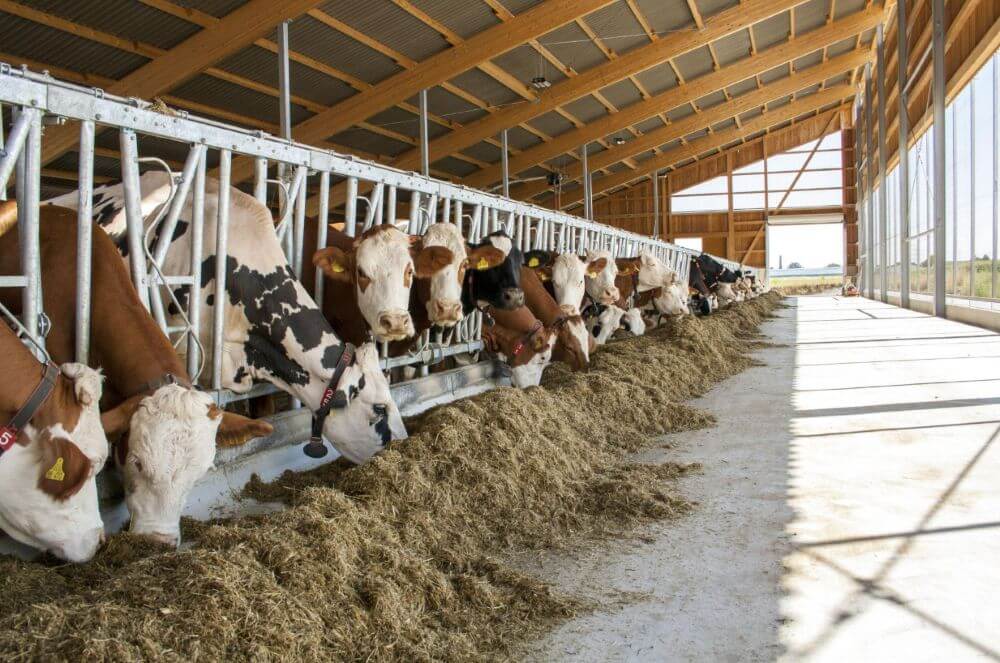
Preventing and controlling diseases can contribute to healthier and more productive dairy herds.
Important management practices include:
-
Implementing appropriate vaccination programs.
-
Maintaining regular veterinary monitoring.
-
Preventing and managing mastitis.
-
Controlling parasitic infections.
-
Maintaining suitable housing and hygiene conditions.
-
Supporting reproductive health and animal welfare.
According to FAO, improved animal health can increase productivity and feed efficiency, potentially reducing methane emission intensity.
4.2. Improving Feed Conversion Efficiency
Feed efficiency refers to the amount of milk or other animal products obtained relative to feed intake.
Improving this ratio means that animals can produce a given quantity of milk with a more efficient use of feed resources.
Better feed digestibility, balanced rations, appropriate herd management, and selective breeding can all contribute to improved feed efficiency.
However, increasing milk production does not automatically guarantee a reduction in total methane emissions. Both daily emissions and emissions per unit of milk must be considered when evaluating the environmental performance of a dairy production system.
5. Genetic Selection and Breeding for Lower Methane Emissions
Genetic improvement offers another long-term opportunity for methane mitigation in dairy farming.
Research has identified natural differences between individual animals in their methane production. These differences have encouraged scientists to investigate whether methane-related traits can be incorporated into breeding programs.
Selective breeding can focus on animals with desirable characteristics, including:
-
Higher feed efficiency.
-
Improved reproductive performance.
-
Better disease resistance.
-
Greater adaptability to local production conditions.
-
Lower methane emissions relative to milk production.
According to a 2025 review published in Animal, direct methane measurements and predictions based on milk mid-infrared spectroscopy are among the approaches being investigated to support low-methane breeding programs.
However, genetic selection requires reliable measurement methods and balanced breeding objectives. Selecting animals exclusively for low methane production could have unintended consequences for milk production or other economically important traits.
For this reason, methane-related characteristics should be considered alongside productivity, animal health, fertility, and overall herd performance.
6. Improving Manure Management to Reduce Methane Emissions
In addition to enteric fermentation, manure management provides important opportunities to reduce methane emissions from dairy farms.
Several techniques have been investigated to control methane production during manure collection, storage, and treatment.
6.1. Anaerobic Digestion and Biogas Production
Anaerobic digestion is a process in which microorganisms break down organic matter in the absence of oxygen.
In dairy farming, this technology can be used to process manure and capture the methane produced during decomposition.
The resulting biogas can be collected and used as a renewable energy source, for example, in electricity generation, heating, or upgraded biomethane production.
Unlike uncontrolled manure storage, a properly designed and gas-tight anaerobic digestion system captures methane for productive use rather than allowing it to escape directly into the atmosphere.
FAO identifies biogas collection and utilization as an effective manure methane mitigation approach. However, controlling methane leakage throughout the system is essential to achieving environmental benefits.
6.2. Reducing Manure Storage Time
The duration of manure storage can influence methane production.
Longer storage periods under anaerobic conditions allow more time for methanogenic microorganisms to decompose organic matter and generate methane.
Reducing unnecessary storage time and removing manure more frequently can therefore limit methane formation in certain production systems.
However, the effectiveness of this strategy depends on manure characteristics and the conditions of the storage system.
6.3. Controlling Manure Storage Temperature
Temperature influences the activity of microorganisms responsible for methane production.
Lower manure storage temperatures can reduce methanogenic activity and consequently decrease methane formation.
According to the FAO report, reducing the temperature of stored cattle slurry by 1–2°C has been associated with a 5–10% reduction in methane emissions in the studies reviewed.
Nevertheless, cooling systems may require additional energy and investment. Their overall environmental and economic benefits should therefore be evaluated under local farm conditions.
6.4. Manure Separation and Treatment
Solid-liquid separation is another manure management technique that can contribute to methane mitigation.
This process separates the solid fraction from the liquid portion of manure, removing part of the organic matter before the remaining material enters storage.
By reducing the amount of organic material available for anaerobic decomposition, solids separation can help limit methane formation under suitable conditions.
The effectiveness of this approach depends on the separation technology, manure composition, and subsequent storage and treatment practices.
7. Improving Grazing and Pasture Management
Pasture management can influence feed quality, animal productivity, and methane emissions.
Poor grazing management may result in reduced forage availability and lower feed digestibility, potentially affecting animal performance and feed utilization.
Improved grazing practices can support more efficient forage use and better nutritional conditions for dairy cattle.
Some recommended practices include:
-
Rotational grazing to manage pasture utilization.
-
Maintaining appropriate stocking rates.
-
Selecting forage species suitable for local conditions.
-
Preventing excessive grazing pressure.
-
Maintaining adequate pasture quality and productivity.
FAO identifies improved grazing management and the use of high-quality forage as important components of livestock methane mitigation.
The results, however, depend on climate, pasture characteristics, soil conditions, and the overall production system.
8. Monitoring and Measuring Methane Emissions
Implementing methane reduction strategies requires reliable methods for measuring and monitoring emissions.
Without appropriate measurements, it can be difficult to determine whether a particular intervention is effective or how it influences the overall environmental performance of a dairy farm.
Several methods are currently used or investigated to estimate methane emissions, including:
Animal-based measurement: Techniques such as respiration chambers and tracer methods can measure methane production from individual animals.
Infrared spectroscopy: Milk mid-infrared spectroscopy is being investigated as a tool for predicting methane-related traits and supporting genetic selection.
Farm-level monitoring: Measurements and emission models can be used to estimate methane emissions from manure storage and other farm operations.
It is also important to distinguish between total methane emissions and methane emission intensity.
Total emissions represent the overall amount of methane released, whereas emission intensity measures methane emissions relative to a unit of milk produced.
Monitoring both indicators provides a more complete understanding of the effectiveness of methane mitigation practices.
9. Combining Different Strategies for Greater Effectiveness
No single approach can address every source of methane emissions in dairy farming.
The most appropriate mitigation strategy depends on the production system, available resources, animal genetics, feeding practices, and manure management infrastructure.
For example, a farm using total mixed ration feeding may be able to incorporate methane-reducing feed additives more easily than a farm relying primarily on grazing.
Similarly, farms with liquid manure storage may benefit from anaerobic digestion or improved storage management, while other production systems may require different interventions.
A 2025 review published in Animal highlights the importance of combining breeding, feeding, and manure management strategies to reduce methane emissions while maintaining dairy productivity.
An integrated approach may therefore include:
-
Improving forage quality and nutritional management.
-
Maintaining animal health and reproductive performance.
-
Evaluating scientifically validated methane-reducing feed additives.
-
Improving feed efficiency through balanced nutrition and herd management.
-
Adopting suitable manure treatment and biogas technologies.
-
Monitoring methane emissions and evaluating mitigation results.
Combining complementary measures can provide broader benefits than relying on a single intervention, although the effectiveness of specific combinations should be assessed under real farm conditions.
10. The Role of Integrated Dairy Production in Sustainability
Methane reduction is closely connected to the broader efficiency of the dairy supply chain. Farm management, raw milk quality, animal nutrition, and processing operations all contribute to the overall performance of dairy production.
An integrated production system can provide better coordination between livestock farming, agricultural activities, milk collection, and processing. This coordination can support more efficient resource management and improve traceability throughout the production chain.
For example, ChaltaFarm's integrated dairy operations combine agricultural activities, livestock farming, and dairy processing within a connected production structure. The company emphasizes intelligent feed and forage management, responsible resource use, and sustainable agricultural practices as part of its approach to dairy production. Its product portfolio includes skim milk powder and other dairy powders, as well as butter products.
Although downstream dairy processing does not directly eliminate methane generated during cattle digestion, improving coordination across the supply chain is relevant to broader sustainability objectives. Evaluating environmental performance across different stages of production provides a more complete picture than considering farm emissions alone.
Conclusion
Reducing methane emissions in dairy farming requires a comprehensive approach that addresses both enteric fermentation and manure management.
Improvements in forage quality, balanced feeding, animal health, genetic selection, and manure treatment can all contribute to lowering methane emissions or reducing emissions per unit of milk produced.
Emerging technologies, including 3-NOP supplementation, seaweed-based feed additives, and advanced biogas systems, are also expanding the range of available mitigation options. However, their effectiveness and practical suitability depend on scientific validation, regulatory requirements, investment costs, and local farming conditions.
As research continues to advance, combining established farm management practices with emerging methane-reduction technologies will remain an important part of developing more sustainable dairy production systems.
The long-term objective is not simply to reduce emissions, but to achieve more efficient milk production while maintaining animal health, productivity, and responsible resource management.
Related Blogs

.webp)

.jpg)