

.svg)
.svg)
.svg)
.svg)
.svg)
 русский
 فارسی
فارسی العربية
 English
 Dairy Powder
  Creamer
  Butter
  Cream
Cream  Milk
Milk  Cheese
 Sweet Whey Powder vs Permeate Powder for Food Industry: Key Differences and Best Uses
Sweet whey powder and permeate powder differ in composition, production process, and functionality despite both being derived from whey. Understanding their protein and lactose content helps manufacturers choose the right ingredient for nutrition, texture, flavor, and cost efficiency.
In the dairy industry, whey-based ingredients play a crucial role in both nutrition and food formulation. Among the most commonly used are sweet whey powder and permeate powder. Although they may seem similar at first glance, these two ingredients differ significantly in composition, production process, functionality, and application in the food industry and industrial food processing.
In recent years, advances in Membrane Technology have enabled a much more precise fractionation of whey components, directly influencing the development of products such as sweet whey powder and permeate powder. Sweet whey powder, due to its valuable whey proteins, holds high nutritional significance and is recognized in Nutrition Science as a rich source of essential amino acids. This makes it highly beneficial for improving dietary quality and for use in fortified food formulations and industrial applications. In contrast, permeate powder, with its focus on lactose and mineral content, plays a more functional and economic role, helping manufacturers maintain sensory quality while reducing formulation costs in large-scale food production.
From a processing standpoint, the differences between these two ingredients become particularly evident in thermal reactions, especially the Maillard Reaction. Sweet whey powder, containing both protein and lactose, can generate more complex flavor compounds and desirable browning, which is especially important in bakery and chocolate applications within the food industry. On the other hand, permeate powder, due to its high lactose and low protein content, is more effective in enhancing crispiness, improving texture, and increasing product volume. These characteristics have made permeate a widely used, cost-effective solution in industries such as snack production.
Understanding Whey: A By-Product with Value
Both sweet whey powder and permeate powder are derived from whey — the liquid by-product remaining after milk coagulation during cheese production. Before coagulation, milk is often standardized or concentrated depending on the cheese-making method. This step has a direct impact on the final composition of whey and its derivatives.
Modern dairy processing technologies, especially ultrafiltration (UF) and membrane separation methods such as reverse osmosis, allow manufacturers to fractionate whey into different components, leading to products like whey protein concentrates, permeates, and lactose-rich powders used in food manufacturing applications.
What is Sweet Whey Powder?
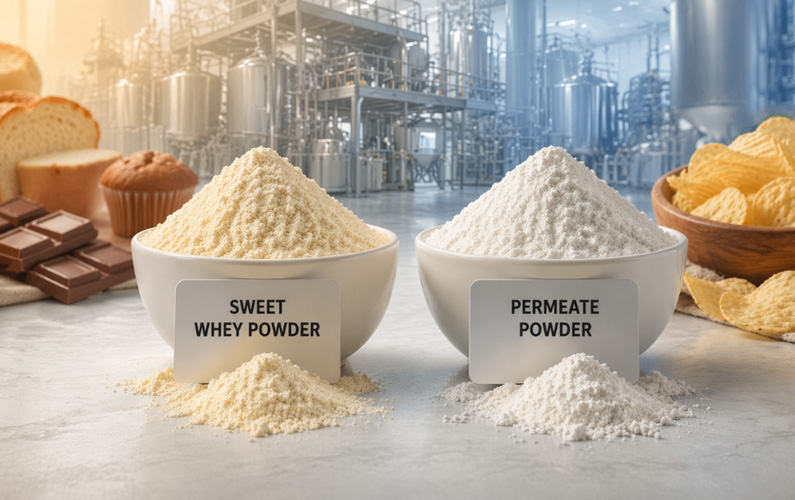
Sweet whey powder is produced from whey obtained during the manufacture of rennet-coagulated cheeses (such as cheddar or gouda). After pasteurization and drying, it becomes a versatile dairy ingredient.
Key Characteristics:
-
Typically contains around 10–13% protein
-
Rich in lactose (approximately 70–75%)
-
Contains minerals and small amounts of fat
-
Mild, slightly sweet dairy flavor
Functional Benefits:
Sweet whey powder is valued for its nutritional contribution, particularly its protein content. It also improves:
-
Browning (Maillard reaction)
-
Flavor development
-
Texture in bakery and confectionery products
It is commonly used in bakery, dairy products, chocolate, and processed foods where both nutrition and functionality matter.
What is Permeate Powder?
Permeate powder is produced after whey undergoes ultrafiltration (UF), where proteins are removed and concentrated separately. The remaining liquid — called permeate — is then dried into powder.
Key Characteristics:
-
Contains low protein (typically ≤5%)
-
Very high in lactose (up to 85% or more)
-
Rich in minerals
-
Lower cost compared to whey powder
Functional Benefits:
Permeate powder is primarily used for its functional and economic advantages, rather than protein content. It helps:
-
Enhance flavor and mouthfeel
-
Provide bulk and volume
-
Improve browning and crispiness
-
Reduce formulation costs
It is widely used in snack products (chips, puffs), bakery items, sauces, and processed foods where lactose plays a key role in texture and taste.
The Role of Processing Technology
One of the main reasons for the difference between these two products lies in the milk concentration stage before cheese production.
-
In traditional cheese production, more protein is lost into whey, resulting in higher-protein sweet whey powder.
-
In UF cheese production, milk is concentrated before coagulation. This retains more protein in the curd, leaving less protein in the whey, which leads to low-protein permeate powder after filtration.
Additionally, membrane processes like reverse osmosis help concentrate whey by removing water, increasing efficiency in drying and powder production.
Key Differences at a Glance
| Feature | Sweet Whey Powder | Permeate Powder |
|---|---|---|
| Protein Content | ~10–13% | ≤5% |
| Lactose Content | ~70–75% | ~80–85% |
| Production | From traditional cheese whey | From ultrafiltered whey |
| Main Purpose | Nutrition + functionality | Cost reduction + functionality |
| Applications | Bakery, dairy, chocolate | Snacks, chips, sauces |
Chaltafarm Product Spotlight
If you are sourcing high-quality whey ingredients, Chaltafarm offers both options tailored for different industrial needs. Our sweet whey powder provides a balanced composition with valuable protein content, making it suitable for nutritional and functional applications. Meanwhile, our permeate powder is an economical solution rich in lactose, ideal for improving texture, flavor, and bulk in products like snacks and baked goods.
Final Thoughts
While both sweet whey powder and permeate powder originate from the same raw material, their differences in processing, composition, and functionality make them suitable for distinct applications in the food industry and industrial food production. Choosing the right ingredient depends on whether your priority is protein enrichment or cost-effective formulation with improved texture and flavor.
Understanding these differences helps manufacturers optimize both product quality and production efficiency.
Related Blogs

.jpg)